
The famine of the Fall profoundly unbalanced the human psyche. Masculine aspects were amplified by the all-consuming quest for food, while feminine aspects were avoided, denigrated, punished and repressed to minimise emotional pain.
The violent psyche that emerged from the Fall swept away the peaceful, goddess-worshipping cultures of the Neolithic Age.
A positive attitude to sexuality existed in pre-patriarchal cultures such as the Minoans of Crete (c. 2700-1450 BC). “[It] contributed to the generally peaceful and harmonious spirit predominant in Cretan life,” Riane Eisler writes in The Chalice and the Blade.
Genesis 2:25 confirms the absence of body shame prior to the Fall. “Although the man and his wife were both naked, they were not ashamed.”
However, famine-affected cultures “exhibit a general intolerance and anxious aggressivity [sic] towards the basic biological expressions of… touching and body contact… Prolonged famine and starvation produce profound disturbances in the capacity for… sexual expression,” James DeMeo writes in Saharasia.
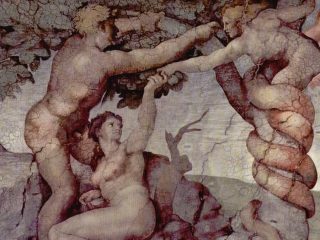
The first intimation of this new paradigm of body shame comes in Genesis 3:7. “Right away they saw what they had done, and they realised they were naked. Then they sewed fig leaves together to make something to cover themselves.”
The unclean feminine
As multi-generational famine impacted, natural feminine functions became unclean and subject to suppression, repression and taboo: “Any woman who gives birth to a daughter is unclean for two weeks, just as she is during her period.” (Leviticus 12:5)
Obsessions with bloodlines and sexual purity developed: “Some Israelite men have married foreign women… Our own officials and leaders were the first to commit this disgusting sin…” (Ezra 9:2)
Women lived in constant fear of violating these taboos—with death often the penalty: “If the man was right and there is no proof that his bride was a virgin, the men of the town will take the woman to the door of her father’s house and stone her to death.” (Deuteronomy 22:20-21)
Emotions, physical touch, sexuality and femininity of any form became painful, dangerous to express, and a source of acute anxiety. The entire feminine side of human nature became traumatised.
Shame
The traumatisation of everything feminine gave rise to shame. Shame stems from unconsciously judging our emotions, bodies and sexuality as socially unacceptable.
Sex became inherently shameful, acceptable only for the purpose of procreation: “After having sex, both the man and the woman must take a bath, but they still remain unclean until evening.” (Leviticus 15:18)
Throughout the Old Testament, nudity—whether chosen or enforced as punishment—is a mark of shame. It particularly vexes the prophets: “She let everyone see her naked body and didn’t care if they knew she was a prostitute.” (Ezekiel 23:18) “You will suffer the shame of going naked.” (Isaiah 47:3) “I will pull up your skirt and let nations and kingdoms stare at your nakedness.” (Nahum 3:5)
Nudity and improper sexuality weren’t the only forms of shame. For women, being unmarried or childless was shameful:
- “Marry me and take away my disgrace.” (Isaiah 4:1)
- “You will be disgraced like a married woman who never had children.” (Isaiah 23:4)
At a time with a high adult male mortality rate, women were expected to contribute to the survival of the tribe by giving birth—particularly to sons. The story of Judah and Tamar (Genesis 38) shows one widow’s determination to have a child. (See Jonathan Kirsch’s The Harlot by the Side of the Road for analysis of this and other “forbidden tales of the Bible.”)
Both offenders and their families were shamed. In Deuteronomy 22:20-21 (see above) the victim must be stoned to death outside her father’s door. Shaming the entire family amplified trauma to encourage compliance.
“Virginity represents the ‘honour’ of the girl, and, more importantly, of her family.” — Steve Taylor, The Fall
“Correct your children”
To avoid the shame and anxiety of violating taboos, emotions had to be shut down during childhood: “Correct your children before it’s too late; if you don’t punish them you are destroying them.” (Proverbs 19:18)
“The ‘good’ child would be increasingly defined in terms of… the absence of emotion or feeling.” — James DeMeo, Saharasia
Abusing children destroyed their capacity to feel: “Children don’t have the right to demand of their parents, ‘What have you done to make us what we are?’” (Isaiah 45:10) That destruction is still with us today. In The Politics of Experience (1967), psychiatrist R.D. Laing writes that “What we call ‘normal’ is a product of repression, denial, splitting, projection, introjection and other forms of destructive action on experience.”
Famine turned farmers and hunter-gatherers into warriors. It also created an aversion to human touch and sexuality; destroyed the bond between mothers and infants, and broke the intimate connection between people and the Creation that had previously met all their needs—our innate connection with God.
Even the phrase ‘masculine and feminine,’ with masculine first, is a product of this imbalance.
Energetic imbalance
The masculine-feminine energetic imbalance that occurred at the Fall cannot be taken into the New Earth. The fallen world, the Old Earth, feeds on the fruit of the Tree of Knowledge of Good and Evil. This means it’s a polarised environment: this or that. The New Earth—where we feed on the fruit of the Tree of Life—is a unified environment: this and that.
The shamed feminine, with its associated body shame, sexual shame, distorted notions of sexual purity and dysfunctional sexual expression, is where humanity is furthest from God. As such, it’s the place of deepest ignorance, superstition, pain, resentment and resistance.
It’s the place where many people would rather die than align with the oneness of creation.
Early psychoanalyst Wilhelm Reich (1897-1957) writes of “the fundamental identity between sexual process and life process.” Our disturbed sexuality is a manifestation of our disturbed genital energy. The Fall affected our connection to life itself.
Jesus created the potential for our reconnection to true life. “I have come to bring you life, and life in all its fullness” (John 10:10). We must clear our genital trauma to access that life. Yet the fear and shame surrounding sexuality for the past six millennia can be overwhelming.
“It will no doubt require the work of many generations before sexuality is taken seriously by official science and the laity, probably not until the social questions of life and death bear in upon us the absolute necessity of comprehending and mastering the sexual process.” — Wilhelm Reich, The Function of the Orgasm
Until we do, the genetic collapse of humanity can only accelerate.
I will write more on this in the fullness of time, and behind the fig leaf of a paywall.
Image: Adam and Eve by Lucas Cranach the Elder, 1526 (Wikimedia)







.jpg)