On Easter Sunday I heard a sermon that included a recapitulation of Genesis chapters 2 and 3: Adam and Eve, temptation and Fall. The preacher phrased this as Adam and Eve making the wrong choice, a mistake for which humanity has been paying ever since.
This is a superficial reading of the text, but it strikes me as incongruous. (I’m setting aside the whole he-said/she-said thing with Eve getting blamed. Personally, I believe that’s a case of ‘history being written by the winners’—in this case, men.)
The restaurant in the Garden of Eden
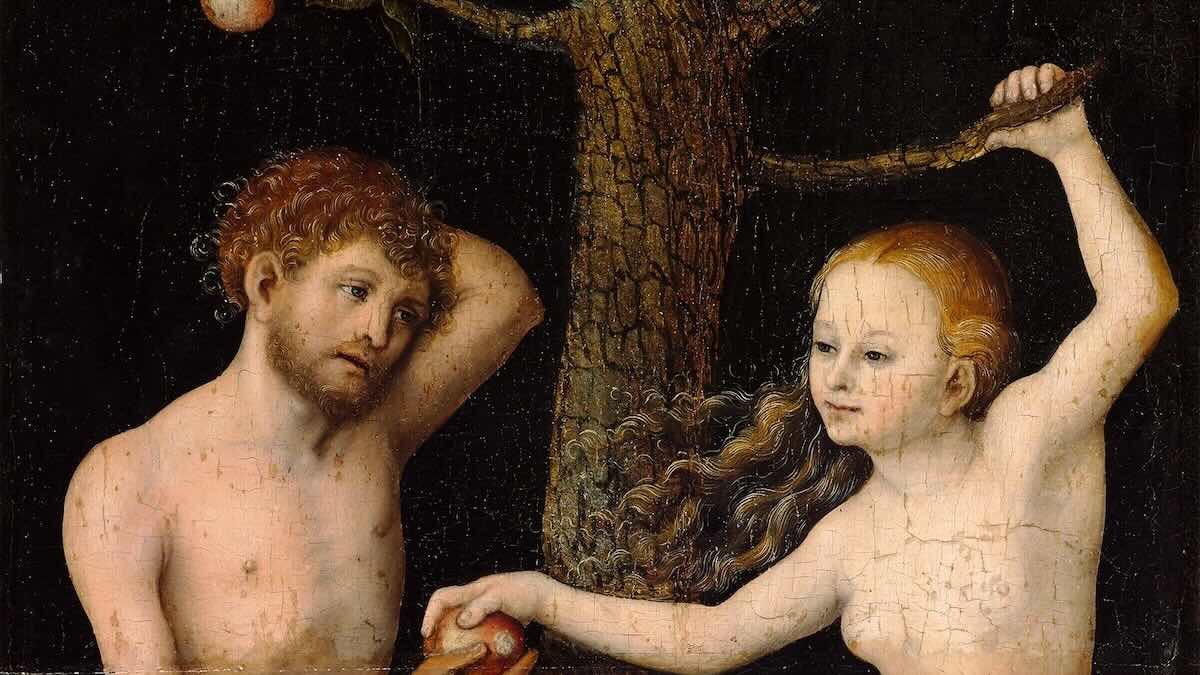
It makes it sound like the Garden of Eden was a restaurant that served beautiful fruit. Adam and Eve popped in for lunch one day. God swanned up in his waiter’s apron, pencil behind an ear. He handed them each a menu and said, “You may eat fruit from any tree in the garden, except the one that has the power to let you know the difference between right and wrong.” (Genesis 2:16-17, Contemporary English Version)
Adam and Eve stared at the menu. It was one of those Chinese menus with glossy photos. The pear, the fig, the pomegranate all looked good… but the apple “looked beautiful and tasty.” (Genesis 3:6)
Eve, being somewhat contrary (which I can strongly relate to), ordered the forbidden fruit. The rest is history.
There’s a whiff of truth to this, but also the acrid stench of smoke and mirrors. What kind of perverse god dangles wisdom before us but demands instead both blind obedience and ignorance? Not one that I can believe in.
The phrase “let you know the difference between right and wrong” suggests the knowledge of good and evil is just a snippet of useful information, like the time of the next bus or a half-time score in a football match. Yet the whole bloodthirsty history of what we call civilization spirals down from Adam and Eve’s menu choice.
What if it wasn’t exactly a choice?
True choice
There are two kinds of choice. Choices made freely, and choices made under pressure: dilemmas. These are two very different things. Equally, there are two kinds of dilemma.
In Story, his masterful vivisection of screenwriting, Robert McKee writes that “The choice between good and evil or between right and wrong is no choice at all.” (We should bear that in mind when considering the Bible or, for that matter, the whole of Christian doctrine.)
McKee continues: “True choice is dilemma. It occurs in two situations. First, a choice between irreconcilable goods… Second, a choice between the lesser of two evils.”
‘Irreconcilable goods’ means there are two things you want. Saying ‘yes’ to one of them means saying ‘no’ to the other. Getting what you want is great, but there’s a downside.
‘Lesser of two evils’ means one of two bad things will happen to you. You can stop one of them by choosing the other. But you can’t stop both.
Adam and Eve – choice or dilemma?
The Bible gives no sense of Adam and Eve facing any kind of dilemma, not even a choice of irreconcilable goods. Aside from the apple, they could eat from as many trees as they liked.
Yet the geographical, anthropological, and—above all—the emotional history of the Middle East in the millennia leading up to the writing of the Old Testament show this was a ‘lesser evils’ situation—with implications that increasingly bear down on us today.
In Saharasia, geographer James DeMeo demonstrates how the first patriarchal societies emerged in the equatorial belt from the Sahara, through the Middle East and Arabia and into central Asia some six millennia ago.
The driver was climate change. Long-term drought caused desertification which then caused famine. This is extensively documented in the Old Testament.
Deuteronomy 28:21-24 reads: “The Lord will make the sky overhead seem like a bronze roof that keeps out the rain, and the ground under your feet will become as hard as iron. Your crops will be scorched by the hot east wind or ruined by mildew. He will send dust and sandstorms instead of rain, and you will be wiped out.”
Us and them
For the first time in history, humans fought over food and water. The split between ‘us’ and ‘them’ appeared. This is what that snippet of intriguing information, the knowledge of good and evil, entails.
The Bible paints a bleak picture of the rapacious civilizations that ultimately conquered the world and provided the model for modern society’s appetite for destruction. The Israelites were one of those early cultures—until a bigger predator swallowed them.
In The Fall, Steve Taylor writes: “The main event in human history is a sudden, massive regression—a dramatic shift from harmony to chaos, from peace to war, from life-affirmation to gloom, or from sanity to madness” around 6,000 years ago.
That’s the choice Adam and Eve made for us. The other option was extinction.
Maybe they made the best choice after all?
The task now—the task that Jesus calls us to—is to undo the effects of the Fall and return to innocence. This is not the blissful ignorance offered in Genesis 2. It’s innocence that includes full knowledge of the destructiveness of good and evil. Now, that is a god I can believe in.
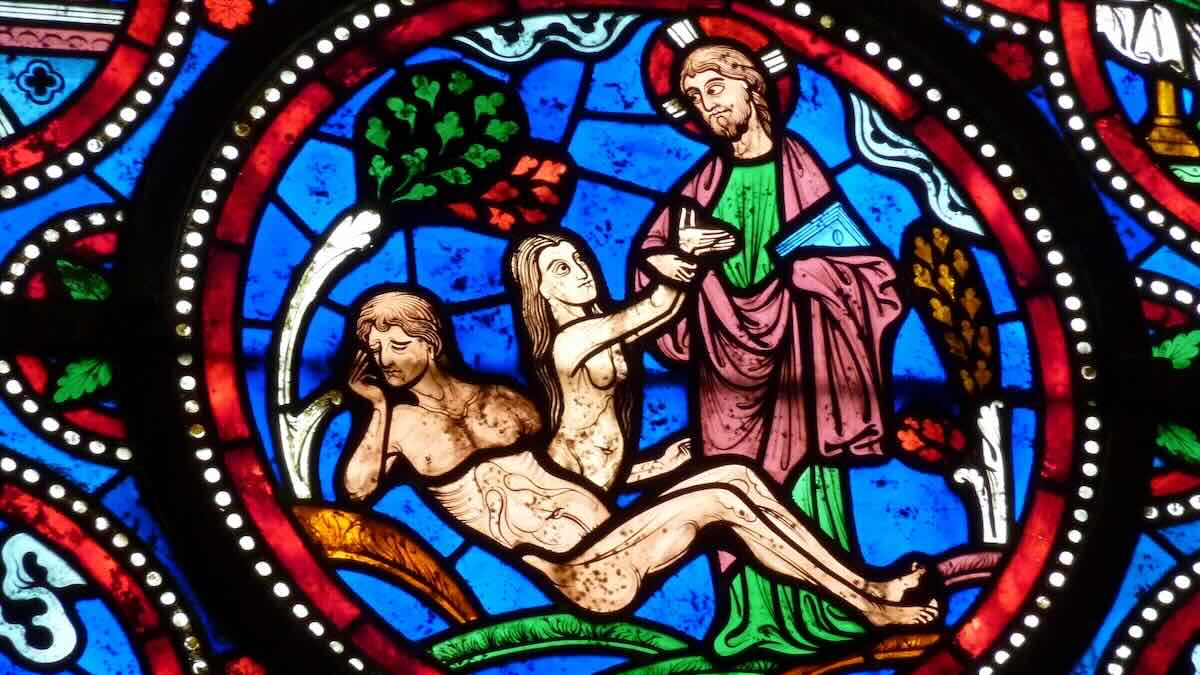
Image: Adam and Eve, Cathedral of St Julien, Le Mans, France (Wikimedia)